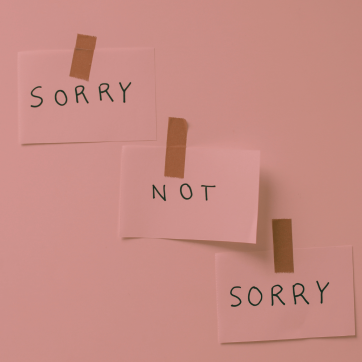
Why Do I Keep Hiding in My Business?

Why do I keep hiding in my business? It’s rarely a confidence problem. Find out who you’re hiding from, what hiding looks like and how to get seen for real.
Last updated: 13 September 2026
I’d build a client a marketing strategy.
It would be good. She’d agree it was good.
Then she wouldn’t publish it.
This happened so often that I had to stop treating it as a marketing problem.
Here’s the thing.
You keep hiding in your business because some part of you doesn’t believe it’s safe to be seen. It’s rarely about confidence. You’re usually hiding from a specific person, an old fear of judgement, or the risk of being fully yourself in public.
And you just need more confidence?
I call bullshit.
Below, I’ll show you what hiding really looks like, why confidence isn’t the fix and what to do instead.
What does hiding in your business look like?
Hiding in your business looks like staying busy with everything except the thing that would get you seen. It rarely feels like hiding. It feels like being sensible, thorough or not quite ready.
Sound familiar?
- You rewrite your website instead of sending the email.
- You do another course before you launch the offer.
- You keep your copy vague, so nobody can disagree with it.
- You hide the unusual part of your work from people you know.
- You say “I just need to fix this first”.
- You feel your heart race and your voice shake when you introduce yourself.
None of that means you’re lazy.
It usually means you’re protecting yourself.
The trouble is that hiding feels safe, but it costs you the clients who were looking for exactly what you do.
Why isn’t confidence the answer to hiding in your business?
Confidence isn’t the answer because many women who hide are already capable and confident in their work. They’re brilliant with clients. What frightens them is being seen, judged and misunderstood in public.
“You just need more confidence” turns that into a personal flaw.
There’s a bigger pattern at work too. In experiments with over 4,000 adults and over 10,000 school-aged youth, economists Christine Exley and Judd Kessler found a large gender gap in how people described their own performance.
The study, published in The Quarterly Journal of Economics in 2022, found the gap on a male-typed maths and science task. It appeared as early as sixth grade.
That’s one study, and it doesn’t explain every woman’s experience. But it does make “just be more confident” look pretty thin.
You can’t positive-think your way out of something you’ve been learning since you were a kid.
What is the witch wound?
The witch wound is a name for the deep feeling that it isn’t safe for a woman to be fully seen. It’s a lens I use, and other people use the term too. It isn’t a clinical diagnosis.
Here’s how I’d say it across a kitchen table.
You’ve learned that being too good, too loud, too strange or too visible can get you into trouble. So you keep your head down.
I’ve had my own. Much of my fear of being seen came from being put down by other women. I had to see it for what it was before I could do anything about it.
The other reason I moved through it was my daughter. I didn’t want to pass it on to her.
That’s the bit that gets me.
Who else is paying for your hiding?
Can you be visible and still be hiding?
Yes. You can be highly visible and still be hiding if people can’t tell what makes you different. Being seen isn’t the same as being chosen.
Raimona was always the fill-in speaker. She’d step in, deliver well and be engaging.
People would nod and smile. Then they’d leave.
No conversations. No clients.
She sounded good, but she didn’t sound distinct.
So we rebuilt her story. The next time she spoke, four women waited for her afterwards. They didn’t want to compliment her. They wanted to work with her.
She made $7,000 that day.
Same speaker. Different story.
Confidence wasn’t her problem. She was already on the stage.
| What’s happening | What it looks like | What helps |
|---|---|---|
| Hiding from the work | You don’t publish | Name who you’re worried about |
| Hiding in plain sight | You show up, but you sound like everyone else | Tell the story only you can tell |
| Hiding part of yourself | You leave out what makes your work different | Say what it is and what it does |
Who are you really hiding from?
You’re usually hiding from one person, such as an old boss, a mentor, a former client or a woman who once made you feel small. Once you name that person, you can question the fear.
It’s generally someone who’s too busy to notice you.
A client of mine was scared to launch her offer because she thought her old mentor would say she’d ripped off the work. She’d actually built on it and added her own perspective.
When she finally launched, her mentor saw it. Her mentor told her it was about damn time and offered her a guest spot.
That’s why I created a five-step process called “Your Not That Interesting”.
It gets the fear out of your head and onto paper, where it’s much easier to deal with.
Scared to Email Your List? Who You're Really Hiding From.
How do you stop hiding in your business?
You stop hiding by making the fear specific, doing one visible thing and telling a story that sounds like you. You don’t have to wait until you feel fearless. You may never get that email.
- Name who you’re hiding from. Use a real person, not “everyone”.
- Check the risk. How likely are they to see it, and how much would they care?
- Pick one visible action. Send the email, publish the page or say yes to the talk.
- Tell the truth about your work. Use the story you’ve been leaving out.
- Watch what happens. Look at who responds, not who you imagined would judge you.
If your fear is affecting your daily life, please talk to a mental health professional. A marketing strategy isn’t a substitute for that.
For everyone else, the next step is smaller than you think.
FAQs: hiding in your business
Q: Why am I scared to be visible in my business? A: Being visible means people can judge you, misunderstand you or disagree with you. That can feel risky, especially if you’ve been put down before. Name who you’re worried about, then look at how likely it is that they’ll see it or care.
Q: Is fear of visibility the same as imposter syndrome? A: They can overlap, but they aren’t the same. Imposter syndrome is doubting that you deserve your success. Fear of visibility is about what might happen when people see you. You might know you’re good at your work and still be frightened of being seen.
Q: How do I stop playing small in my business? A: Choose one specific action you’ve been avoiding, then do it. Send the email, publish the offer or say yes to the talk. Waiting to feel ready keeps you stuck, so make the next step small enough that you’ll actually take it.
Q: Do I need to be confident to promote my business? A: No. You need a clear message, a true story and a next step you’re willing to take. Confidence often comes after you’ve done the thing, not before. Raimona’s confidence wasn’t what changed. Her story was.
So what do you do now?
You don’t need a confidence makeover.
You need to find out who you’ve been hiding from, and whether they’re even looking.
Most of the time, they’re not.
And when they are, they may just tell you it’s about damn time.
Start with “You’re Not That Interesting”, my free 5-minute training to help you get out of your own way and press publish.
You're Not That Interesting, Get the free training.
What have you been “just fixing” instead of publishing? Tell me in the comments.
About Eve John: Eve John is a copywriter, story-based marketing strategist and the founder of Dauntlexx. She’s the author of three books and has worked with women on confidence since 2001 and women in business since 2014.